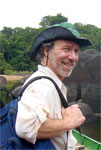
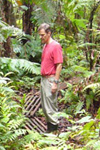
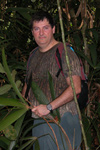
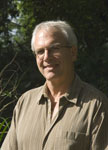
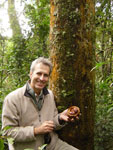
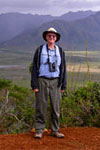
Dr. Mark Plotkin, President of the non-profit Amazon Conservation Team
Indigenous people are key to rainforest conservation efforts -- 10/31/2006
Tropical rainforests house hundreds of thousands of species of plants, many of which hold promise for their compounds which can be used to ward off pests and fight human disease. No one understands the secrets of these plants better than Indigenous shamans -- medicine men and women -- who have developed boundless knowledge of this library of flora for curing everything from foot rot to diabetes. But like the forests themselves, the knowledge of these botanical wizards is fast-disappearing due to deforestation and profound cultural transformation among younger generations. Dr. Mark Plotkin, President of the non-profit Amazon Conservation Team, is working to stop this fate by partnering with Indigenous people to conserve biodiversity, health, and culture in South American rainforests. Plotkin, a renowned ethnobotanist and accomplished author who was named one of Time Magazine's environmental "Heroes for the Planet," has spent parts of the past 25 years living and working with shamans in Latin America. Through his experiences, Plotkin has concluded that conservation and the well-being of Indigenous people are intrinsically linked -- in forests inhabited by Indigenous populations, you can't have one without the other.
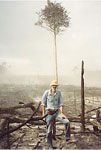
Dr. Philip Fearnside, Research Professor at the National Institute for Research in the Amazon in Manaus, Brazil
Global warming could cause catastrophic die-off of Amazon rainforest by 2080 -- 10/22/2006
For the Amazon, there is an immense threat looming on the horizon: climate change could well cause most of the Amazon rainforest to disappear by the end of the century. Dr. Philip Fearnside, a Research Professor at the National Institute for Research in the Amazon in Manaus, Brazil and one of the most cited scientists on the subject of climate change, understands the threat well. Having spent more than 30 years in Brazil and now recognized as one of the world's foremost experts on the Amazon rainforest, Fearnside is working to do nothing less than to save this remarkable ecosystem.
Dr. Daniel Nepstad, Director of the Woods Hole Research Center's Amazon program
Amazon rainforest at a tipping point but globalization could help save it -- 06/04/2007
The Amazon basin is home to the world's largest rainforest, an ecosystem that supports perhaps 30 percent of the world's terrestrial species, stores vast amounts of carbon, and exerts considerable influence on global weather patterns and climate. Few would dispute that it is one of the planet's most important landscapes. Despite its scale the Amazon is also one of the fastest changing ecosystems, largely as a result of human activities, including deforestation, forest fires, and, increasingly, climate change. Few people understand these impacts better than Dr. Daniel Nepstad, one of the world's foremost experts on the Amazon rainforest. Now head of the Woods Hole Research Center's Amazon program in Bel�m, Brazil, Nepstad has spent more than 23 years in the Amazon, studying subjects ranging from forest fires and forest management policy to sustainable development. Nepstad says the Amazon is presently at a point unlike any he's ever seen, one where there are unparalleled risks and opportunities. While he's hopeful about some of the trends, he knows the Amazon faces difficult and immediate challenges.
Dr. Carlos Peres, Amazon specialist at the University of East Anglia
Subtle threats could ruin the Amazon rainforest -- 11/07/2007
While the mention of Amazon destruction usually conjures up images of vast stretches of felled and burned rainforest trees, cattle ranches, and vast soybean farms, some of the biggest threats to the Amazon rainforest are barely perceptible from above. Selective logging and 6-inch high "surface" fires are turning parts of the Amazon into a tinderbox, putting the world's largest rainforest at risk of ever-more severe forest fires. At the same time, market-driven hunting is impoverishing some areas of seed dispersers and predators, making it more difficult for forests to recover. Climate change -- and its forecast impacts on the Amazon basin -- further looms large over the horizon. Few people understand these threats better than Dr. Carlos Peres of the University of East Anglia, a native Brazilian who grew up in an Amazonian city with the rainforest as his backyard.
William F. Laurance, president of the Association for Tropical Biology and Conservation
Rainforests face myriad of threats says leading Amazon scholar -- 10/16/2006
The world's tropical rainforests are in trouble. Spurred by a global commodity boom and continuing poverty in some of the world's poorest regions, deforestation rates have increased since the close of the 1990s. The usual threats to forests -- agricultural conversion, wildlife poaching, uncontrolled logging, and road construction -- could soon be rivaled, and even exceeded, by climate change and rising levels of carbon dioxide in the atmosphere.
Rainforest plant expert Pierre-Michel Forget
France needs to act to protect French Guiana's rainforests -- 12/19/2006
Understanding relationships between plants and animals is key to understanding rainforest ecology. Dr. Pierre-Michel Forget of the Mus�um National d�Histoire Naturelle in France is a renowned expert on the interdependency between rainforest trees and seed dispersers. Author of dozens of papers on tropical forest ecology, Dr Forget is increasingly concerned about deforestation and biodiversity loss in forests of the Guiana Shield region of Northern South America. In particular he sees the invasion of informal gold miners, known as garimpeiros, as a significant threat to forests in French Guiana, Suriname, Guyana and Venezuela.
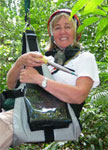
Dr. Margaret D. Lowman, Director of Environmental Initiatives at New College of Florida
Canopy research is key to understanding rainforests -- 11/28/2006
The canopy is the most biodiverse part of the rainforest, but due to its inaccessibility, it has been notoriously difficult to study. Over the years a number different techniques have been used to learn more about this biologically rich layer. Today you can find cranes, canopy walkways, ultra-lite planes, dirigible balloons and balloon-rafts, ski-lift-style trams, and remote-controlled pulley systems being employed to provide access to the canopy. Familiar with these efforts is Dr. Margaret D. Lowman, Director of Environmental Initiatives at New College of Florida. Known as "CanopyMeg" to her friends, Lowman has been exploring the rainforest canopy for over 25 years, developing an expertise for the use of different canopy access techniques while authoring over 95 peer-reviewed publications and three books. Recognized as a world-renowned canopy expert, Lowman today focuses on science education and rainforest conservation, and frequently speaks about her adventures to groups ranging from elementary school classes to corporate executives.
David L. Pearson, research professor at the School of Life Sciences at Arizona State University
A look at the biodiversity extinction crisis -- 10/06/2006
As tropical forests -- the world's biological treasure troves -- continue to dwindle, biologists are racing to devise ways to save them and their resident biodiversity. While many conservation biologists talk about population viability analysis and intricacies of reserve layouts, David L. Pearson, a research professor at the School of Life Sciences at Arizona State University (ASU) in Tempe, Arizona, focuses on a different approach: education. Pearson, whose work includes hundreds of books and papers including a series of beautifully illustrated wildlife guides for regions in Latin America, believes that lack of knowledge about ecosystems is one of the most significant hurdles to addressing the present biodiversity crisis. Fluent in five languages and able to "get along" in several more, Pearson conducts week-long workshops around the world to explain the basics of biodiversity and introduce "critical thinking" to audiences that include local government officials, business people, educators, students, and environmentalists. Pearson's trips are largely self-financed, though he says seeing the enthusiasm of workshop participants in developing countries is reward in and of itself.
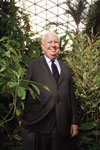
Peter Raven, director of the Missouri Botanical Garden
Biodiversity extinction crisis looms says renowned biologist -- 03/12/2007
While there is considerable debate over the scale at which biodiversity extinction is occurring, there is little doubt we are presently in an age where species loss is well above the established biological norm. Extinction has certainly occurred in the past, and in fact, it is the fate of all species, but today the rate appears to be at least 100 times the background rate of one species per million per year and may be headed towards a magnitude thousands of times greater. Few people know more about extinction than Dr. Peter Raven, director of the Missouri Botanical Garden. He is the author of hundreds of scientific papers and books, and has an encyclopedic list of achievements and accolades from a lifetime of biological research. These make him one of the world's preeminent biodiversity experts. He is also extremely worried about the present biodiversity crisis, one that has been termed the sixth great extinction.